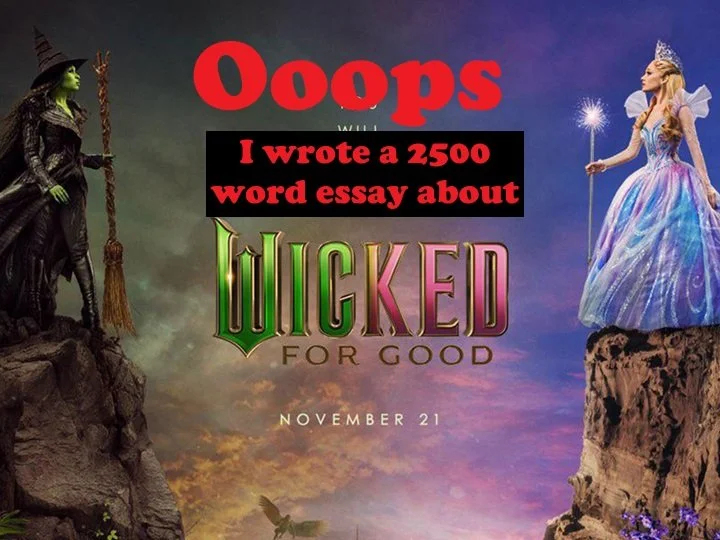
Ooops, I wrote a whole essay about “Wicked: For Good”
I know I said I was going to take December off—but I said that before I saw Wicked: For Good. Now that I’ve seen it, I’ve got to talk about the movie (and, by extension, its predecessor—Wicked and the stage show both are adapted from.)
I’ll start right here by saying I really do enjoy both of these movies. I own the Blu-Ray of the first movie and expect the same will happen with this one. I emphasize that because I’m worried that it’s about to sound like I’m not a fan.
Both of these films are among my favorites from the respective years they were released and I readily recommend anyone even a little interested in seeing these movies check out the first one. (And if you like it, continue on to For Good.)
All of this is to say I came away from the film with thoughts and opinions about how things were done. In my mind, that is a mark of interesting art and, in this case, art that I quite like and admire.
Bearing that in mind, let’s get into what I think is keeping Wicked: For Good from being great.
I like Jon M. Chu as Director
I want to start with a fairly unambiguous positive; that being Jon M. Chu as director.
Between In the Heights and both Wicked movies, I feel comfortable saying I like Jon M. Chu as a musical director more than pretty much any musical director of the current century. (Rob Marshall is maybe his main source of competition in my mind.)
Chu imbues rhythm and timing to simple actions happening with extras in the corners of the screen. These small moments—like a poster being plastered or a road being swept—manage to emphasize and add to the musicality of a moment. It generally gives an extra kick to the movie’s musical experience in a way that lets it begin to emulate the thrill of watching an in-person Broadway performance. Even with the opening number of the first Wicked, the way he and his cast/crew decide to emphasize the lines “No one mourns the wicked!” with the stopping of feet in a celebratory dance number even when those words are being sung for the dozenth time never fails to give me goosebumps. The sound design emphasizes this movement, letting the footsteps play as though they’re a percussive bit of instrumentation within the composition.
At it’s best, this helps give the filmed musical the extra punch that is often lacking in other filmed musicals. At it’s (infrequent) worst, I maybe have a moment or two where I feel like I’m hearing more of the movement of the people singing rather than their actual voices. (Again, I can only remember having this thought once and it hasn’t been an issue on repeat viewings.)
Chu also seems to understand that film is a different medium and is willing to adjust the material so as not to be too slavish to the the Broadway staging purely for the sake of it if there’s another strong option. For better or for worse, this is evident in the opening of Wicked: For Good. We get some musical motifs from the first film that were added in to the opening number that bear in mind that this is a sequel film (and it’s own artifact) rather than a second act of a contiguous production. These little lines, thus, act to remind people what happened previously and helps remind them of a lot of the songs from that first movie they liked. (Which is helpful since the songs in For Good are not as strong on average.) There is a larger conversation to be had about whether or not this deserved to be two films (I’m, to my own surprise, am more in favor of it than I expected) but whether that decision is right or wrong, Chu takes that decision into consideration when adapting the material. Some will probably find his handling of that decision to be sloppy, but I am mostly impressed by how much he changes without deviating from the general spirit of the original. (I am, perhaps, still recovering from how much swaths of the The Hobbit movies managed to loose the plot while adapting a single book into a trilogy of two-hours-plus films.)
That said, there is a lot of extra baggage that comes when you are making an adaptation between mediums. Chu made (or at least signed off on) decisions that impact the material. While I find most of those decision to be strong in the best way (a darker tone for this film feels right as opposed to the “wink wink, nudge nudge” humor of the stage production’s second act) there are some that are stranger than others.
There are issues that I had, but some of those are inherit to the matieral that is being adapted.
Wicked: For Good’s inherited sins
The second act of Wicked has always been strange and that was even more emphasized to me seeing Wicked: For Good. I first saw the stage production back in the late aughts or early 2010s and I hadn’t closely looked back at the musical’s second act since then.
Beyond the less potent songs of the second act, the bigger issue I have is that, in order to get a “full” experience out of part two, you are required to remember most of the major plot beats and character interactions of The Wizard of Oz. A movie I love, but also a movie that is close to 90 years old and, while most people have seen it, might not have stuck in the memory of every viewer. (There was a small child sitting in front of me during my screening that was asking “Mom, what happened?” after Elphaba gets doused with water and sinks into the floor. This feels like a problem with both the film and stage adaptation as the staging of that moment is hard to read if you haven’t seen The Wizard of Oz; yes, there’s a line that foreshadows her melting, but if you don’t know the other movie, then I think that would be very easy to miss.)
The biggest problem happens after arguably the best song of Wicked: For Good. “No Good Deed” is meant to be a character shift for Elphaba. She has put up with too much of the ire of the people she has been trying to help and swears, “No good deed will I do again!” We are then meant to understand that, all of the mean things she does to Dorothy Gale (the main character from The Wizard of Oz) in the 1939 film are the product of her anger and frustration.
The issue for me as someone viewing Wicked (both on stage and in film) is that, while I am aware of all of that stuff (“How about a little fire, Scarecrow?” and “Poppies will put them to sleep!” as well as “And your little dog, too!”, etc.) those moment aren’t being performed by the character I’ve been watching in this version story. I’ve been following a much more sympathetic version of the Wicked Witch, surely seeing those moments play out—even if similarly—would be done with performative difference from Cynthia Erivo or Idina Menzel when compared to Margaret Hamilton’s classic cackling character. Thus the powerful promise Erivo ends her show stopping number with feels toothless in the context of the show it actually exists in.
To a certain degree, this is an unavoidable problem. The nature of The Wizard of Oz’s copyright means that the books are public domain, but the movie itself is still owned by Warner Bros. So the events and exact imagery from the film everyone is familiar with couldn’t be depicted one-to-one, and even versions of those scenes that veer too close to the original would be difficult to do while keeping copyright.
My hope had been that we’d get some choice scenes in the now 2-hour-and-thirty-minute version of act two. This would flesh out Elphaba’s heel turn and let Dorothy be a little bit more of a character in this story where she’s being used as a political pawn. However, even if the movie did do what I hoped, it would run into the same problem—The Wizard of Oz is copyrighted, so the people who are familiar with the movie would suddenly be faced with much different scenes than what they saw in the film they’re perhaps holding in the back of their mind while watching Wicked.
Now, instead, those who haven’t seen it or don’t remember it are left somewhat in the dark.
I feel there could have been a happy medium where we maybe get to see a small bit of Dorothy in just a scene or two and then we perhaps recreate the melting of the Wicked Witch of the West in a way that makes that scene a bit more readable for those unfamiliar with the source material.
That said, what was executed on in the film is—I think—an accurate depiction (for better or worse) of how the stage show handles things. Simple as it is to say these other scenes should have been included, I do feel that doing so in practice is not as strong or memorable a choice. Thus, I can see what that was not the road taken.
A quick detour Into the Woods
There is a big problem I have with Wicked: For Good and, oddly, it is the same problem (er, one of them) that I had with the film adaptation of Into the Woods.
In the Into the Woods film, an odd moral quandary is created by the adaptation that wasn’t as underlined in the original. (Light spoilers for Into the Woods.) In the original stage production of Into the Woods, there is a dedicated narrator—a distinct, physically manifest character who exists on stage yet apart from all the others. During act two, that narrator is killed in order to emphasize how off the rails things have gone for the characters in the show and create even more of a feeling that they are not protected by a “happily ever after.”
The movie Into the Woods does not have a dedicated narrator, instead, this duty goes to The Baker. The Baker, does not die during act two—however, the narration he was doing still stops at that point; thus, when at the end of the show he starts telling the story to his child, I’m left to believe that he is purposely excluding the second half of the show’s story from his child. He is, after all, picking up the same narration, presumably with the same premature ending.
This moment is open a bit more for interpretation in the stage production when he begins telling the story; the audience is left to wonder which parts of the story he will tell, but it doesn’t have an implied answer. Now, in the movie, we are—intentionally or not—nudged into believing he is telling only the act one portion of the story to his child. While that portion of the story mostly makes up the traditional tellings of the respective fairy tales depicted there, it fails to include the lessons the characters learn in act two and also omits the death of that child’s mother.
This is an interesting and likely unintentional quirk of the film adaptation of Into the Woods. It’s a choice I don’t love, but has made me think about that “text” more deeply and thus made me consider what aspects of a story I personally feel are worth telling and carrying forward. Storytelling—whether fictitious or factual—is editing and omitting for an audience. There will always be things that happen in the margins that a narrator needs to weigh the importance of for their audience.
In Into the Woods, this change from the film adaptation is an annoyance to me, but one with novelty that gets me reconsidering the original in an engaging way.
When Wicked: For Good does the same thing, I’m left considering the material more deeply, but also feeling frustrated.
(Major Wicked: For Good spoilers ahead.)
At the very start of both stage and first film adaptation of Wicked, we are presented with a Munchkin asking Glinda, “Is it true you were her friend?” Glinda then admits that they did know each other and we then go into a flashback of their school days together. The implication in both versions is that Glinda is start to tell the citizens of Oz the full story of what happened.
However, in Wicked: For Good, when we catch up with that moment, we see that she does not—in fact—tell them the whole story. When we rejoin with the moment from the first movie where she (one imagines) begins telling the story, we pull out to reveal that she has more she has to say, and what she does have to say reveals little to nothing of Elphaba’s story.
While Glinda does seem to call for unity and is presumably successful, the truth about Elphaba, the Wizard, and Shiz all remain obscured from the citizens of Oz. While, yes, the liars have been chased off or detained, their propaganda and calumnies are allowed to flourish without Glinda voicing truth, despite the fact that she is effectively the only one who could do so with authority at this point.
“There are little blonde girls in this country who have no idea they can be beautiful”
The last 20-minutes of Wicked: For Good made me think of this scene from the T.V. show 30 Rock, where one of the characters (Jenna) advocates for a blonde Disney princess because “There actually hasn’t been a white [Disney] princess since 1991.”
I think I get this feeling because of two things: Glinda doesn’t tell Elphaba’s story in the film (at least, not overtly) and Glinda is said to be able to now read the Grimoire—a skill that was effectively exclusive to Elphaba (only two other characters really seem able to read or interpret portions).
I think there is a feeling at the end of the movie that—purposeful or not—that proves the thesis of the song “Popular” correct: “We have to think of celebrated heads of state or especially great communicators, did they have brains or knowledge? Don’t make me laugh. They were popular.”
I don’t think Wicked: For Good is quite isn’t meant to prove that line fully correct. I believe the show know that, ideally, a person who is popular is also a person who can do good. The show also acknowledges that those two attributes rarely go together. The end of the movie is the intended to be the synthesis of both Glinda and Elphaba's respective philosophies—now being carried out by solely Glinda. Glinda is the new figurehead of Oz, but—because she knew Elphaba—she is able to both be popular and do good.
This isn’t an idea absent from the stage show, but it feels like the addition of Glinda being able to read the Grimoire, combined with her overtly not telling Elphaba’s story, makes the final product lean even more into this notion that Glinda is the only way a positive message can get to the people of Oz.
Again, this is a notion not divorced from the intent of the original show, but all of those things in concert do make me feel a little hollow, especially when isolated to a viewing experience that is just the second half of Wicked. If Glinda can read the magic book that only Elphaba could read, if Glinda has the popularity to rally those around her to gain political power, if Glinda doesn’t bother to inform the people of Oz about the truth of her friend—then what was the point of Elphaba?
Obviously, Elphaba would still be vital in teaching Glinda to use those powers for good, Elphaba is still a vital part of getting Oz to where it is meant to be. That said, these two small tweaks (I should not that Glinda not telling Elphaba’s story is, perhaps, less a “tweak” and a too literal translation of what happens on stage) do a lot to veer my personal reading of the movie into the territory of illustrating Elphaba as a magical colored woman who only exists to further Glinda’s character art so that Glinda can do the important thing at the end. This would feel a timely and topical message were it not for the fact that Glinda and Elphaba are meant to be very close friends (history will call them roommates) by the end of Wicked: For Good, even despite differences and tumult.
I concede that this, perhaps could have been the original point of the stage production and that bit of satire didn’t occur to me when I saw it more than a decade ago. That said, if it is a conclusion that the movie intended to reach, it feels like it downplays it. The Grimoire being readable by Glinda seems meant to be enduring and the not telling of Elphaba’s story is part of a gag that let’s the audience think the end of the second movie might just segway back into the first movie again (thus allowing Glinda to break the cycle, get it?). Driving home notions of power and who gets to wield it is undeniably a part of the text of Wicked, but it doesn’t seem to be the thing on its mind in these last moments of For Good even as it makes changes that underline those notions of power.
It is not off base for a Wicked movie to show that people could only ultimately be convinced of the truth by a charismatic, conventionally attractive, white woman rather than the colored woman living on the fringes of society. In fact, I would say that emphasizing that particular theme is a thing worth doing.
My issue is that the implication of Glinda revealing the whole truth of their societal flaws is removed. The horror of suppressing the talking animals is relieved, but the people of Oz are never forced to even considering how to grapple with their own buy-in to propaganda or how the mechanisms of their society lead them to this place. They are deprived the opportunity to reflect and improve for everyone.
I really really loved Wicked: For Good, but I think I would have adored it if Glinda had been less focused on doing good and more focused on doing right. Right by Elphaba and right by the people of Oz, giving them the information that could help move them toward lasting societal change rather than a temporary reprieve that leaves the shrewd mechanisms of the “Wonderful Wizard of Oz” fully concealed.
*****
Hey! You finished my latest blog post. If you enjoyed this and want to keep up to date, consider scrolling to the bottom of this page and signing up for e-mail updates so you can have stuff like this sent right to your inbox.
Light Keeper Chronicle: The Unspoken Prophecy is available for physical purchase from Schuler Books, Barnes & Noble, and Amazon or wherever you read ebooks.
The Wilderlands is available for physical purchase now from Barnes & Noble and Amazon or wherever you read ebooks. The audiobook is also out now on most major platforms.