Art I’m Enjoying: ‘Clair Obscur: Expedition 33’
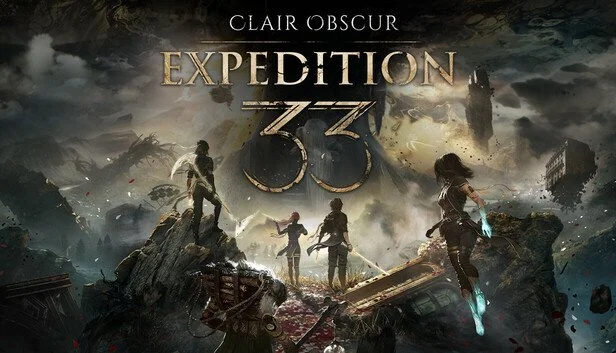
Clair Obscur: Expedition 33 from Sandfall Interative
Overtalked about or not, Clair Obscur: Expedition 33 is a piece of media that I found myself really enjoying.
Released last year, Expedition 33 is the debut video game of French video game development team Sandfall Interative. The narrative takes place in a world that has undergone some sort of cataclysm and now the only known inhabitable city is Lumière, a island that may or may not have once been Paris, France.
This fictionalized island city looks out at a massive, distant mural on the horizon with a number written on it. Every year, the woman who stands sentinel over the mural wakes up and subtracts a number—when this happens, everyone who is that age perishes. Every year following this culling (gommage as the characters call it), an expedition sets out to stop this Paintress from subtracting another number; however, none have ever returns, and none have ever stopped her.
Thus, we find a band of mostly 32-year-olds (the newly made seniors of this society) setting out after the latest gommage took all friends and loved ones of 33.
This is a strong opening hook that the game capitalizes on. It’s not just engaging for the sake of engagement, the text of the game is legitimately interested in grappling with what happens in a society where the oldest citizens are erased every year. The game engages with what this means for the people of Lumière who have to consider their own existence (with death visibly on the horizon) and ask themselves what it will mean to have or not have children when it is guaranteed that child’s life will be fractional in length to their own.
Expedition 33 visually presents a world where I was happy to wander around at a slow pace and just look at the design of the space I was inhabiting. The core cast of characters are also really compelling—so often in narratively big games like this with a team of characters, there will be characters who have a quirk/trait/thing about them that gets repeated ad nauseum. It’s difficult to thread a needle for characters that feel both consistent across the game, yet textured enough to be engaged with, but that is largely executed with aplomb here. (I think the final portion of the game neglects some of these characters, but the pay off is solid enough I largely forgive its shortfalls.)
Another big plus about the game is that (when it comes to the main campaign) the story does really respect your time. I think I beat everything in about 50 hours—which might seem very intimidating if you don’t play a lot of these kinds of games, but 75-100 hours is not unheard of in this genre (and I know there are people who finished in a breezy 30-40 hours). While some of the side content can be tedious, the main story is full steam ahead and doesn’t waste your time.
I don’t think there’s any one thing it does better than any game I’ve played (accepting arguments for music), but it does everything VERY well. Creating maybe the most compelling, easy to recommend package for a turn-based RPG I’ve experienced.
If any or all of that has piqued your interest, I recommend checking it out or reading some other reviews and looking into it.
That said — I do want to talk a little bit about what I do like about the full story and, to do that I’m going to speak in vague terms about the whole narrative front to back. I’ll be vague, but spoilers ahead.
So, if you’re interested and haven’t played it, go check it out now. If you’re willing to roll the dice on possible spoilers, I’ll get into them now.
The big thing I ultimately loved about Expedition 33 was its narrative design. While I think the broad beats of the story make sense in the template of many video game RPGs—plucky protagonists fight monsters until they are powerful enough to kill a deity—I need to applaud the people making the game for not only telling a good story, but telling it well and telling it in such a way that I never knew where it was going.
The game starts with the titular Expedition 33 setting out to kill the Paintress with ships full of people. While I expected those ships to get whittled down to the core cast pretty quickly, it happened much sooner than I expected and in a way that hit the characters hard.
Similarly, one expects the characters to to both undergo losses and meet new characters during their mission. All of these things happen, but in a different order than I’d expected and to different people.
The first of the two big moments that most impressed me came when meeting the Paintress. I knew there would be something more complicated than bad-woman-make-life-number-go-down; her visual design insists there’s more to her than that and the way she’s talked about on the fringes of the narrative implies she is doing this for some sort of reason. When clarity is provided, I found the answer to be earned and compelling and—simultaneously—completely surprising. (Though, I can see how this point onward may have fully shaken some people off the game.)
Following this reveal, there’s a little bit more game to get through before the very end of the game. Going into that final portion, I knew that there was a narrative decision the player had to make at the very end of the game; while I correctly assumed what that decision would be once everything became clear, I didn’t realize how the game was going to frame it.
Given that you drift between at least three different character’s close points of view in the game and acts of the game are named after those characters, I assumed the character who I was playing the final act as would have to make the decision.
Not so.
The game goes to great pains (arguably being a touch too heavy handed at the very end) to emphasize what the main point of view characters believe and why and that two in particular do not believe the same thing. Thus, when the time came to make a decision, two of the main characters face off and—rather than making the decision as one of the characters—the game turned to me and said “Okay, who do you want to play as in the final portion of the game?”
While certainly not the first time a game has done this (I fondly remember Star Wars Epidose III’s video game adaptation letting you pick between playing as Anakin and Obi-Wan and that dictating the game’s end) I hadn’t been expecting it here. Doing this forced me to reflect on the game’s characters and character writing up to this point and, furthermore, made me consider the nature of art that offers escapism. (An aside: one of my favorite movies last year was Kiss of the Spiderwoman, which made me believe in the positive power of escapist art as an idea. Expedition 33 sits firmly on the other side of that, showing how devastating art that provides escapism can be.)
Up to hitting publish on this, I was on the fence about whether or not to shoutout a game like Clair Obscur: Expedition 33 given that it’s a year old and has collected as many accolades as a video game could hope to pick up. That said, it’s still a game that effected me and that I’ve been thinking about as I’ve chipped away at it over the course of this past year, and have been thinking about since beating it.
Anyway, I think that’s everything I’ve got to say about Expedition 33. If you found this interesting, you can read about Other Art I’ve Enjoyed:
*****
Hey! You finished my latest blog post. If you enjoyed this and want to keep up to date, consider scrolling to the bottom of this page and signing up for e-mail updates so you can have stuff like this sent right to your inbox.
Light Keeper Chronicle: The Unspoken Prophecy is available for physical purchase from Schuler Books, Barnes & Noble, and Amazon or wherever you read ebooks.
The Wilderlands is available for physical purchase now from Barnes & Noble and Amazon or wherever you read ebooks. The audiobook is also out now on most major platforms.