Playstation Discontinues Physical Media
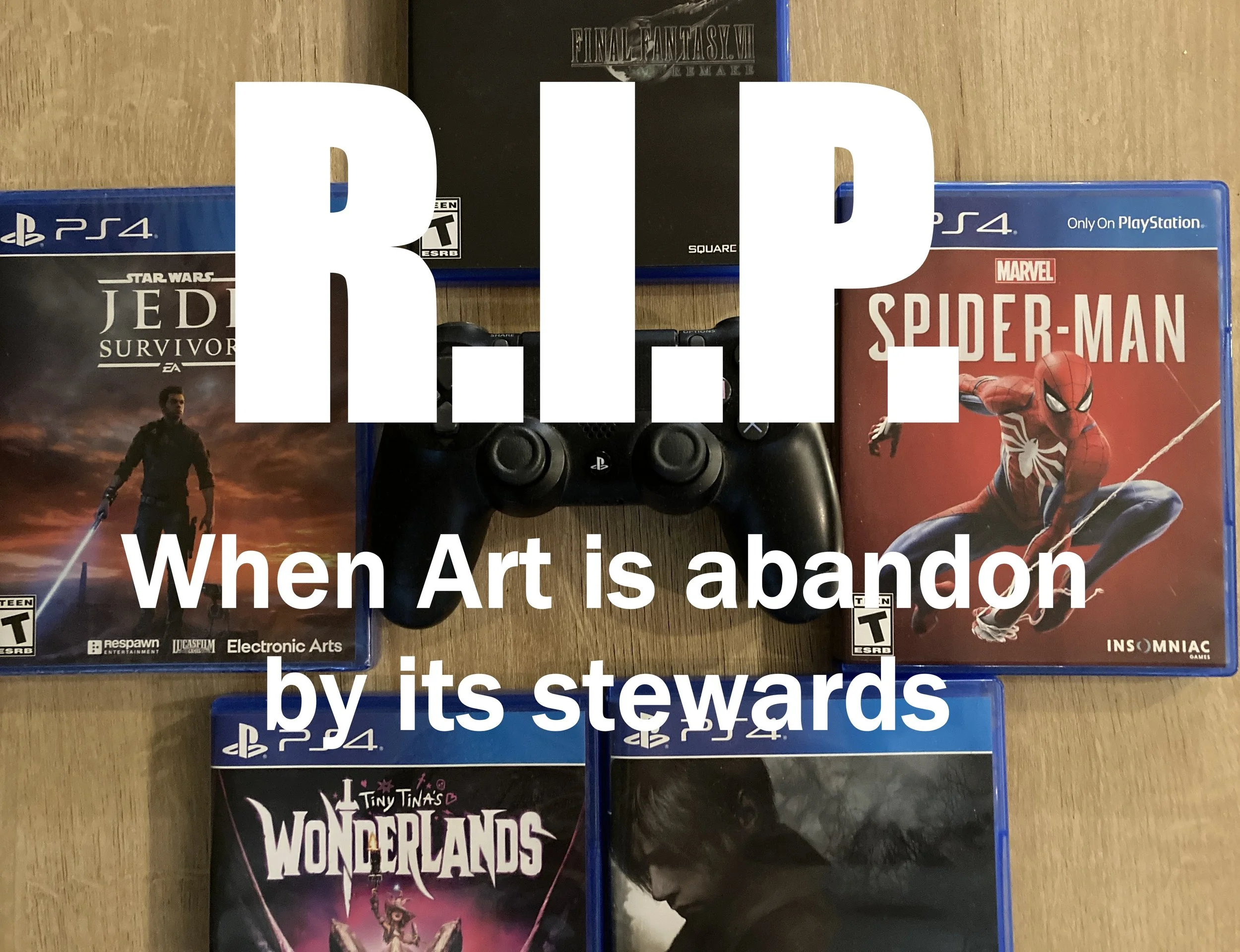
Star Wars: Jedi: Survivor, Final Fantasy VII: Remake, Spider-Man, Tiny Tina’s Wonderlands, and Resident Evil IV Remake on Playstation 4.
This is the third time I’ve done one of these; a pontification on the importance of physical media.
I’ve complained about it enough that I did stop to reflect if this is an issue or just an issue for me.
After all, digital is clearly how most people choose to absorb their media, and not without reason. It’s the main way I experience the bulk of my media. It’s generally inexpensive, relatively accessible, quick to deliver, and doesn’t occupy physical space. I think digital access should 100% be an option and I’m glad it exists.
I’m getting ahead of myself.
Last week, Sony—the company that helped create DVD and Bluray, and is currently the defacto leader in the console video game world—announced it will no longer make physical video games starting in 2028. This comes shortly after Take-Two Interactive announced that Grand Theft Auto VI, which is said to release later this year, will not be released as a physical disc. For context the previous Grand Theft Auto game, as of 2018, is arguably the most profitable single piece of media ever release with a budget of $265 million and $6 billion in gross revenue according to MarketWatch.
There’s a few wrinkles to digital ownership but the big one is that most of the time when you “buy” something digitally, you are not actually buying the item. Be it a book, a movie, or a video game, you tend to be buying a license (a revokable license) to access that media. While it is rare for items to be pulled from libraries once purchased, it does happen. Most recently—days after making the announcement that they’ll stop printing physical game discs—Sony pulled more than 500 movies from customers’ libraries. So, if you’ve ever bought movies like Apocalypse Now, Big Eyes, Terminator 2, Song of the Sea, or Silver Linings Playbook—then give those one last watch before Sept. 1, 2026.
I also admit that I’m nostalgic for the second-hand market this will kill. There were a number of times through my childhood where my brother and I were only able to get a game by buying it used or by being able to borrow a game from a friend. In fact, I’d say until high school, nearly every game I bought myself was bought on deep discount or by getting it used. I think walking into a Gamestop or a Goodwill and not be able to get a used game for current consoles does a disservice to the the interested consumer by making the point of entry harder, the business by killing the second hand market, and the gamemaker by needlessly limiting to can experience their game.
While digital video games are wildly more accessible than when I was 10-years-old, I do think that if 10-year-old me was transplanted to 2028 in a similar situation, the barriers that still exist probably would have kept me from playing video games. (Or, at least, playing Sony’s video games.)
Nintendo and Xbox are still making physical games for now, but Nintendo has been flirting with not selling games on the cartridges they sell and Xbox is in the midst of aggressive cost cutting measures as I write this.
While I understand that when art is made at the scale video games are, there is generally a need for them to be profitable—I think any artist would like for their work to be profitable, at least enough so to fund the next project—I do not believe profitability is the issue here.
When a small indie developer is only able to release a game digitally, I think that is wholly reasonable. Often times, those games can only be made by removing mass physical production as a factor. Frequently, the most popular of those games will also get physical releases of some sort further down the line.
But I think the budget to make a Sony video game has become so ridiculously swollen, that they’re seeking to save money in any place they can. So rather than make fewer high ticket video games, or experiment with lower budget video games that might be wildly successful (to reference another industry, Obsession is the 8th highest grossing movie of 2026 with over $300 million so far on a budget of just $750k) the company has decided to make it so that, if you want to buy a Sony game you must go through Sony. This is exacerbated by reporting that Sony plans to pull back on releases on PC in the future; in the past, that has made their games available through Steam, Epic, and GOG—the latter of which sells games without a digital license!
Let me summarize then what Sony’s decision means come 2028.
You cannot buy anything used.
You cannot get anything from your library.
You cannot borrow from a friend.
You must pay Sony money—assuming they still have the digital store the game is accessible through open. (By the way, Sony is also closing the digital stores for the Playstation 3 and Playstation Vita in one year.)
I think most consumers will, at most, be just slightly annoyed at this. I do think people will adjust to this change very quickly, for 75% of consumers it’s a non-issue.
But given that Sony leads video game consoles and that they helped create the dominate mode of physical video access, I find it horrifying that it has decided physical video games are not worth its time.
If a museum were to fill itself with only the prints and copies of physical art rather than the physical art itself, I think one could still enjoy that museum—but I struggle to imagine how such an institution could be taken seriously among its peers.
If you are interested, here’s some of the other times I’ve lamented the death of physical media:
Disney and Pokémon won’t take my money: How digital stores killed the digital stars
Good-bye “Game Informer”: My (apparently) annual ode to physical media
*****
Hey! You finished my latest blog post. If you enjoyed this and want to keep up to date, consider scrolling to the bottom of this page and signing up for e-mail updates so you can have stuff like this sent right to your inbox.
Light Keeper Chronicle: The Unspoken Prophecy is available for physical purchase from Schuler Books, Barnes & Noble, and Amazon or wherever you read ebooks.
The Wilderlands is available for physical purchase now from Barnes & Noble and Amazon or wherever you read ebooks. The audiobook is also out now on most major platforms.